

How people and planet thinking will drive real climate action
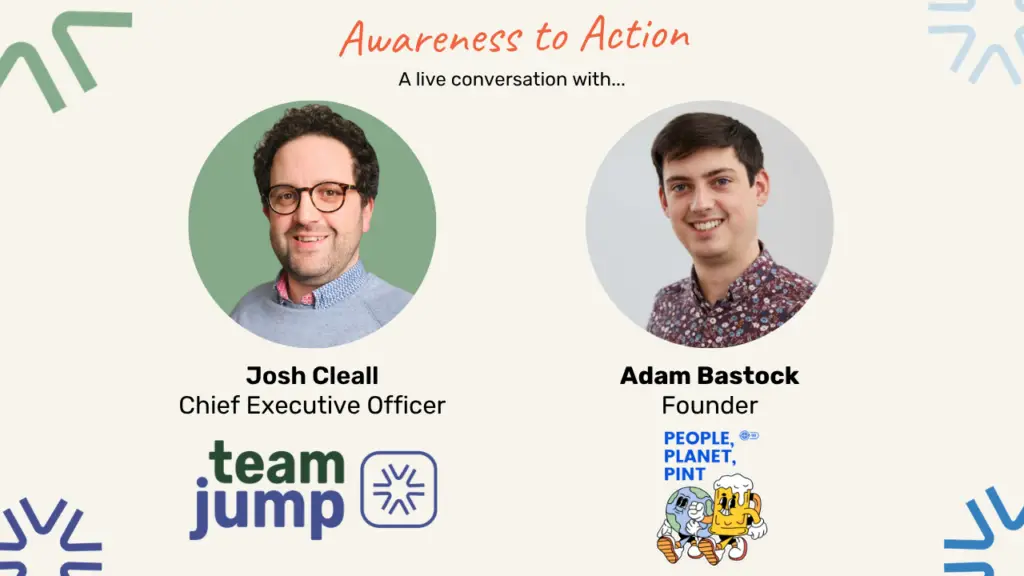
If you want to move from awareness to action, the relationship between people and planet will sit at the heart of your engagement strategy. In the latest episode of our podcast, Awareness to Action, we speak with Adam Bastock, founder of People, Planet, Pint, to explore how informal conversations can lead to behaviour change.
This conversation explored how creating simple, human connections inspires people to take action over time and how community-led approaches outperform one-off campaigns.
Watch the full podcast below:
Informal spaces and the relationship between people and planet
Traditional sustainability events often prioritise presentations over participation, yet real change will happen when people feel able to speak freely about the relationship between people and planet. Adam explains that many events involve “panel sessions where you would hear from four people, but you’ve got a room full of 200 to 300 people… that you just never get to speak to.”
People, Planet, Pint emerges from this gap. It creates a casual environment where individuals can meet, share ideas, and discover others who care about sustainability. As Adam puts it, “there was just a lack of casual space for sustainability conversations.”
These relaxed settings encourage richer discussions because they remove hierarchy and pressure. Conversations become more open and honest, which means participants will explore ideas they might avoid in a formal workplace setting. This approach will help you build trust while also making sustainability feel more accessible.
If you are exploring how engagement environments influence behaviour, you can learn more in our insights on environmental health and workplace priorities.
How community will drive long-term action
One of the most prescient lessons from the podcast is that sustained engagement is the most effective way to put climate action at the fore. Adam highlights that “getting someone into a pub for six months is what is going to change their lives, not a single bit of training.”
Here, Adam is talking about shifting the focus from delivering information to building a relationship between people and planet. Learning from experiences helps to develop confidence, and inevitably, you will create a supportive environment where sustainable behaviour becomes normal.
Community also strengthens emotional connection. Someone may learn about heat pumps in a workshop, but they will only act after speaking to peers who have real experience. As Adam explains, people need “that community support… and hearing personal stories for that action to convert.”
In turn, engagement programmes must go beyond education. They must create ongoing interaction that allows behaviours to embed naturally.
Behaviours that benefit people and planet
Moving from awareness to action requires more than knowledge, and engagement tools must reflect how people and planet connect. The podcast highlights how gamification makes complex ideas easier to understand and far more engaging.
In the Small99 action box, participants play a “higher or lower” game where they rank activities by carbon impact. Adam notes that “it is amazing how many people still get that wrong,” and believe that flights have lower emissions than they do.
However, the most important principle is choice. Instead of being told what to do, individuals select actions themselves. This simple action creates ownership and encourages them to commit to change. As Adam explains, “you never actually give people actions. They pick them themselves.”
This approach will help you design engagement strategies that feel empowering rather than prescriptive. When people actively participate in decision-making, they will take greater responsibility for their actions.
Building a future where climate action becomes the focus
The biggest takeaway from this podcast is that behaviour change will not happen from downward pressure. Instead, sustainable behaviours develop through connection, curiosity, and shared experience around people and planet.
Adam reflects on his own journey, noting that a more approachable method works better than a strict approach. He explains that “you can’t force that upon people… they will go on that journey themselves.”
If you’re ready to create a programme that turns awareness into action, you can request a demo here and start building meaningful engagement across your organisation.