

How does Britain’s largest NHS trust successfully engage thousands of busy healthcare professionals in meaningful climate action? In our latest sustainability engagement masterclass, we explore exactly that.
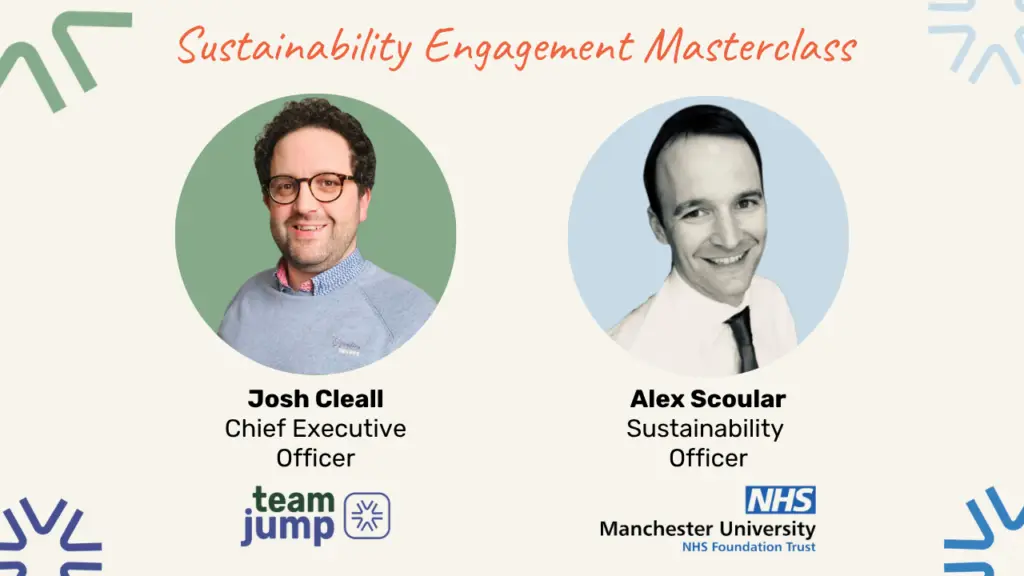
Hosted by our team and featuring Alex Scoular, Sustainability Officer at Manchester Hospitals NHS Foundation Trust (MFT), this session shows how one of the most complex healthcare organisations in the UK builds a culture of sustainable action at scale. With “the equivalent of 30,000 full-time staff” across multiple hospital sites, the challenge is significant, yet the results are clear.
You can watch the full recording here:
Britain’s largest NHS trust shows the scale of healthcare impact
MFT, Britain’s largest NHS trust, operates at an extraordinary scale, which directly shapes its sustainability challenge. As Alex Scoular explains, the organisation delivers “414,000 emergency department attendances a year, 150,000 operations each year, and over half a million tests and investigations.”
This level of activity links to a wider global issue. The healthcare sector accounts for “4.4% of global emissions,” while the NHS alone produces “25 million tons of carbon dioxide equivalent each year.” The session highlights a striking comparison, noting that healthcare emissions are “bigger than aviation,” which sits at around 2.5%.
These figures show why engagement must sit at the centre of any net zero strategy. At this scale, every action taken by staff contributes to measurable impact. Therefore, MFT empowers individuals to understand their role in reducing emissions and improving health outcomes.
Connecting engagement to real-world action
At Britain’s largest NHS trust, sustainability engagement moves beyond awareness and into tangible activities that staff can access every day. Alex Scoular outlines a wide range of touchpoints, including “monthly webinars” with “around 100 attendees,” alongside newsletters with “something like 1,500 subscribers.”
However, what makes the approach effective is its direct connection to action. Programmes such as Green Rewards have already driven “65,000 Green Reward actions” across the organisation. These actions link to real operational changes, including waste reduction and sustainable travel.
The trust also empowers its people through a growing advocate network. The Sustainability Advocate programme now has “over 150 staff” involved, each acting as a champion within their own department.
This approach reflects a broader truth. When engagement connects to daily roles, it becomes part of routine rather than an additional task. You can explore how this aligns with wider NHS priorities in our article on environmental health as the NHS’s next big challenge.
Britain’s largest NHS trust proves behaviour change drives measurable results
One of the most powerful insights from Britain’s largest NHS trust is the clear link between engagement and measurable outcomes. Over recent years, the organisation has achieved a “50% reduction in carbon footprint since 2019,” supported by changes in energy use, waste management, and clinical practice.
At the same time, staff-led initiatives deliver impressive results. The trust highlights “970 tons of clinical waste per year redirected” and a campaign that has saved “7 million single gloves being used.” These are not abstract metrics. They are direct outcomes of engagement that translate into cost savings and environmental benefits.
Even smaller projects contribute to wider impact. The beekeeping initiative has produced “150 kilos of honey over the past five years,” while also raising awareness of biodiversity across the organisation.
These examples show how behaviour change, when scaled across a large workforce, delivers significant results. Engagement becomes a driver of both sustainability and operational efficiency.
The importance of leadership and culture
Leadership plays a critical role in enabling success at Britain’s largest NHS trust. As Alex Scoular explains, “we’ve been really fortunate… to have support from the board level of our trust” from the early stages of their sustainability journey.
This support helps position sustainability as a strategic priority. However, culture remains just as important. The trust recognises that “the biggest challenge is always getting staff” to engage due to time pressures, especially in clinical environments.
To address this, the team takes engagement directly to staff. Instead of expecting participation, they visit wards, meet teams in their own spaces, and work with local champions to build trust. This approach ensures sustainability fits around demanding schedules rather than competing with them.
The session also highlights a key risk. Without sustained investment, organisations will face higher costs in the long term. As Alex Scoular notes, failing to invest in sustainability means “longer term [you are] going to lose out.”
Ready to build engagement at your organisation?
Britain’s largest NHS trust shows what is possible when you combine leadership support with a people-first engagement strategy. The results prove that sustainability becomes achievable when it is embedded into everyday actions.
If you want to engage your workforce, track impact, and drive long-term behaviour change, we will support you every step of the way. You can request a demo today and start building your own sustainability engagement programme.