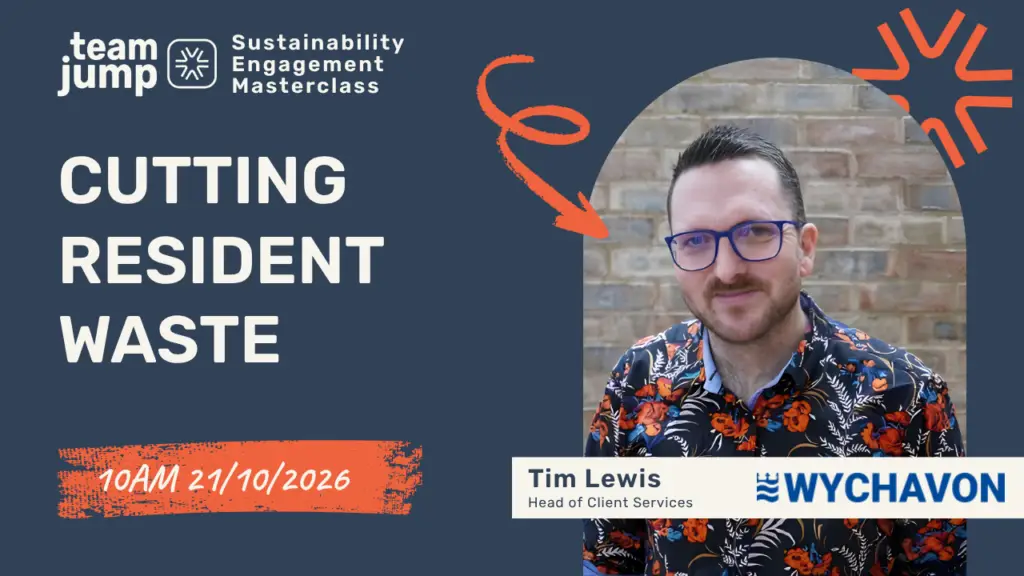


Waste reduction is on every councils minds right now with the rising costs of disposal. That’s why Wychavon District Council is rewarding residents for cutting their waste through their resident rewards programme, run by Team Jump, WYCHRewards.
In our latest Sustainability Engagement Masterclass, Tim Lewis, Head of Client Services at Wychavon District Council, explained how the council is cutting resident waste. He was joined by host Ingrid Espinosa, Engagement Manager at Team Jump. Below you’ll find the rewards and campaigns behind Wychavon’s approach, plus practical steps you can use in your own area.
Watch the full masterclass
The full Sustainability Engagement Masterclass with Tim Lewis, held at 10am on Wednesday 21 October 2026, runs through every campaign in more detail. Key moments:
- Poll results on waste disposal costs and Simpler Recycling
- How Wychavon collects waste and why it launched WYCHRewards
- Power Up and the bin lorry fire footage
- Food Savvy activities and early results
- The TED Says advert and other campaigns
- Q&A on compost bin costs, nappy vouchers and promotion
Key takeaways
- Wychavon builds the waste hierarchy into every WYCHRewards message, so repair and reuse earn more points than quizzes.
- Each month the 6 most active residents win a £50 voucher, and every 6 months the top-scoring ward picks a local charity to receive a donation.
- Real footage of a battery fire in a bin lorry made the Power Up campaign stick, and more residents then used the kerbside electricals collection.
- Early Food Savvy feedback found 73% of respondents cut their food waste, even though Wychavon won’t collect food waste separately until 2028.
- Short themed campaigns keep the programme fresh, and sign-ups rose in line with bursts of social media activity.
Why waste reduction matters for councils in 2026
Waste reduction is now a national target in England as well as a local priority. Defra’s residual waste delivery plan, updated in July 2026, aims to bring residual waste down to 287kg per person by the end of 2042, roughly half the 2019 level. The same plan expects collection and packaging reforms, including Simpler Recycling, to achieve 31% of that reduction. The rest has to come from other measures, and changing what households buy and throw away is one of them.
Council teams already feel the pressure. In a poll at the start of the masterclass, almost every attendee said they were worried about rising waste disposal costs over the next decade. Most also felt Simpler Recycling hadn’t yet done much to change how residents recycle.
Wychavon is a district council in Worcestershire, so it collects household waste while a separate authority disposes of it. Its contractor, FCC, runs alternate weekly collections of residual waste and mixed recycling. Residents can also put batteries and small electricals out at the kerbside, and textiles are collected from the kerbside too.
Simpler Recycling required councils in England to collect food waste weekly from 31 March 2026, but councils tied into existing contracts could agree transitional arrangements. Wychavon’s food waste collections start in 2028 because of its current contract. The council partnered with Team Jump in late 2024 as part of its We Are Wychavon plan, which includes a goal to minimise waste by 31 March 2028.
How WYCHRewards rewards residents for cutting waste
WYCHRewards is a web and mobile app where Wychavon residents log sustainable actions and earn points for them. Waste is one of its core modules, alongside nature, carbon and water, sustainable travel and community engagement.
The waste hierarchy shapes how the points work. “The waste hierarchy anchors basically every message,” Tim said, so prevention and reuse always come before recycling and disposal. Residents earn more points for repairing or reusing an item than for completing a quiz.
The rewards are modest but regular. At the end of each month, the 6 residents with the most points each win a £50 voucher, chosen from a list the council keeps as local as possible. Every 6 months, the highest-scoring ward chooses a local charity to receive a donation. You can read more about rewards for sustainable actions and how gamification works in a Team Jump programme.
Members can also share photos of what they’ve done. Tim’s favourites included a vacuum cleaner with a repaired cord and a second-hand coffee machine bought for £50. Other residents passed an outgrown bike to a neighbour, mended a swimming costume, turned old clothes into a scarecrow for a village competition and rescued a roadside item for a charity shop before it was cleared as fly-tipping.
Each story gives other members a practical idea to copy. The feed lets people like posts but not comment on them, so Team Jump can moderate it with little effort.
Power Up: why showing the danger worked
Power Up was a 3-month WYCHRewards campaign about electricals and batteries, and its biggest lesson was that showing real danger works better than describing it. The campaign opened with a short quiz on common e-waste myths and showed residents the right disposal routes in the district. Repair and reuse earned the most points.
Battery fires are a growing risk for every council. Material Focus counted over 1,200 battery fires in bin lorries and at waste sites across the UK in 2023, a 71% rise on 2022. Selling single-use vapes has been illegal in England since 1 June 2025, but Tim noted that many are still in circulation.
During the masterclass, Tim played footage of a recent fire in one of Wychavon’s recycling lorries. The fire service attended and the crew had to eject the load, so all the recycling in it was lost. Sharing clips like this needed approval because contractors and firefighters appear in them, but the reaction from residents made it worthwhile.
“The shock factor, if you talk about lessons learned, we found that’s worked best… we think that’s actually engaged people more.” Tim Lewis, Wychavon District Council
The campaign changed behaviour as well as awareness. More residents put electricals out for the kerbside collection, and many said they hadn’t known the service existed. Tim admitted the council probably hadn’t promoted it as well as it could have.
Food Savvy: waste reduction before food waste collections arrive
Food Savvy shows that a council can start on food waste reduction years before it collects food waste separately. Worcestershire County Council led the original Food Savvy campaign, and Wychavon added it to WYCHRewards as a 12-week programme residents can join at any time. Members get a new tip by email every 2 weeks and a badge when they finish.
The campaign leads with money. WRAP estimates the average household of four throws away £1,000 of food a year, and Tim said the cost message lands well while living costs are high. Activities include “Plan like a pro” on meal planning and “Banana Hero”, which shows how to stop bananas ripening too fast. Members also shared their own ideas, such as freezing spare meals.
Early feedback is encouraging. About 80 of WYCHRewards’ almost 1,000 members joined Food Savvy in its first few months. Of the first participants to finish the feedback survey, 82% said they were more aware of why food waste is an issue and 73% said they cut their food waste during the campaign. The sample is small, so treat these figures as early signs rather than firm results.
Tim thinks the gap between belief and reality explains the shift.
“There’s a belief that, oh, I don’t have any food waste, and actually, when people start to monitor their own food waste… they realise, oh actually I’ve got a lot of food waste.” Tim Lewis, Wychavon District Council
Waste reduction campaigns beyond the app
Alongside WYCHRewards, Wychavon runs separate waste reduction campaigns, each aimed at one specific problem. The table sums them up.
| Campaign | Problem it targets | What Wychavon did | Early signs |
|---|---|---|---|
| TED Says (Keep Britain Tidy) | Nappies, one of the most common contaminants in Wychavon’s recycling | Bin lorry livery and an animated advert on Sky AdSmart, shown only within the district | Far fewer nappies in recycling samples and a recent waste composition analysis |
| Hypnocat (Material Focus) | Batteries and electricals in household bins | Wychavon-branded Hypnocat on social media and on bin lorries for 12 months | Promotes the kerbside electricals collection |
| Get Composting | No food waste collection until 2028 | Subsidised compost bins, including hot composters and food waste digesters, ordered by postcode | Good take-up from residents new to composting |
| Reusable nappies with The Nappy Lady | Nappy waste and the outdated image of reusables | A £50 voucher for local parents, plus drop-ins at children’s centres and baby banks | Strong interest at drop-in events |
TED Says builds on national research. Keep Britain Tidy found that 7% of nappy users put disposable nappies in their recycling, and reports that up to 85% of contaminating households stopped after seeing the campaign. Wychavon got permission to animate Ted for its advert.
In the Q&A, Tim explained how the subsidised schemes work. Get Composting runs the ordering platform and delivery, and the council pays the agreed subsidy on each bin residents buy, with no other fee. For the nappy vouchers, parents apply with a MAT B1 form or birth certificate plus proof of residence, then The Nappy Lady sends a discount code.
The newer campaigns also reflect a change in how the council listens. Wychavon ran focus groups with residents for the first time.
“We’ve always assumed we know what people think and why people are doing stuff, but… running those focus groups has been a real positive.” Tim Lewis, Wychavon District Council
Tim said one-size-fits-all messages haven’t landed in the past, so the council now varies its tactics by message and audience.
How to apply these waste reduction lessons
You can use Wychavon’s approach to waste reduction in any organisation that wants people to waste less. These steps come from the masterclass and from running the programme with the council.
- Put prevention first in your points. Give repair and reuse more points than quizzes, so the rewards match the waste hierarchy.
- Keep rewards small and frequent. Monthly prizes from local businesses, plus a ward or team competition for a charity donation, give everyone a reason to keep logging.
- Show what goes wrong. For safety issues such as batteries, real footage or local incident data persuades more than written guidance. Get approvals early.
- Refresh with short campaigns. Wychavon runs themed campaigns for about 3 months to stop the programme going stale. Read why one-off campaigns tend to fade and how themed sustainability campaigns fit into a longer programme.
- Let members share proof. A photo feed with likes but no comments spreads practical ideas and stays easy to moderate.
- Review the numbers every quarter. Wychavon and Team Jump meet quarterly to see what worked. Sign-ups rose in line with short bursts of activity on Facebook and Instagram, so the council now focuses its promotion there.
Councils can start where collections lag behind their goals, as Wychavon did with food waste. Our resident engagement programmes for councils use the same mix of rewards and campaigns.
In universities, the same mechanics work well in halls of residence, with inter-hall competitions and repair or swap activities. See how we engage students and staff on campus.
NHS trusts and businesses can weight points towards reuse in staff programmes too. Find out more about sustainability programmes for employees.
Find the gaps in your engagement plan
Book a free Sustainability Engagement Health Check to find the gaps in your resident engagement plan. It’s a 30-minute call with our team, followed by a 2-page scorecard with personalised recommendations. If waste is your main focus, you can also ask about our waste minimisation health check.