

Greener technology needs more than awareness
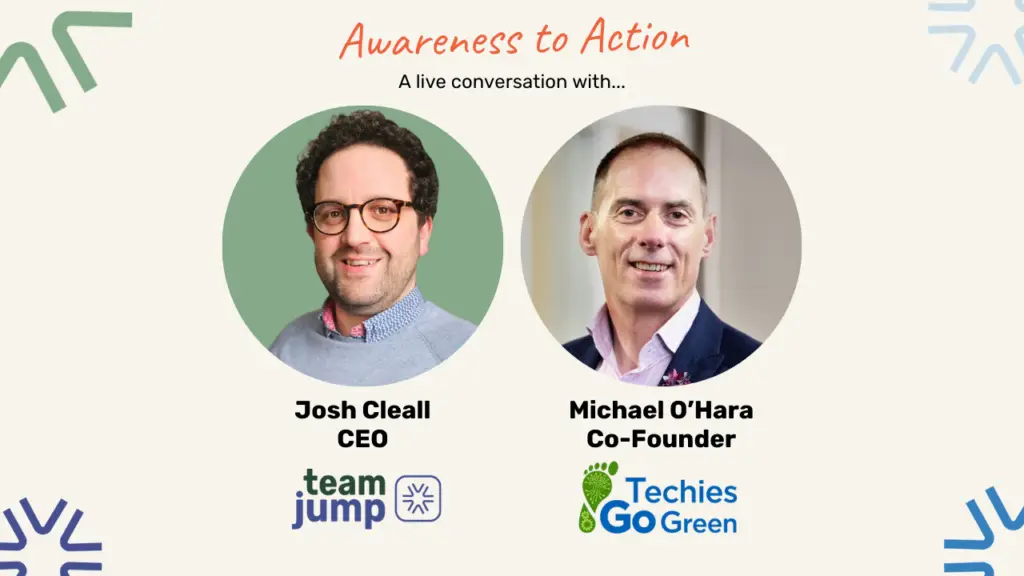
Greener technology is now a business priority, but awareness on its own will not move organisations far enough or fast enough. In our latest Awareness to Action LinkedIn Livestream, we spoke with Michael O’Hara, Co-Founder of Techies Go Green, about what it really takes to turn climate ambition into practical change.
From product design and procurement to leadership and AI, the conversation explored a challenge many organisations now face. You may have a strategy. You may have targets. However, progress only happens when sustainability becomes part of daily decisions.
Why greener technology matters more than ever
Michael founded Techies Go Green in 2021 after making practical changes in his own business during the Covid period. He replaced fossil fuel heating with a heat pump, added solar panels and battery storage, upgraded lighting, and installed EV chargers. That experience shaped a wider mission to help more organisations take meaningful climate action.
Today, Techies Go Green brings together hundreds of member businesses across the UK and Ireland. Its community spans technology, healthcare, finance, construction, tourism, education, and more. The goal is clear. Build awareness, share education, and support action that leads to measurable impact.
For us, that message resonates strongly. At Team Jump, we see every day that sustainability grows faster when you make it visible, practical, and relevant to your people. Our programmes are built to help organisations motivate members, reward action, and turn good intentions into habit-forming behaviour change.
Why awareness rarely delivers greener technology on its own
One of the strongest points from the livestream was simple. Awareness does not automatically create action.
Many organisations invest time in training, workshops, reports, and communications. Those steps matter, and they build a strong foundation. However, people still need the right tools, the right incentives, and the right support if they are going to change how they work.
Michael described a common gap between sustainability commitments and day-to-day operations. A business may publish a net zero target, but that target will have limited impact if sustainability is missing from procurement, product design, supplier relationships, or team KPIs.
That gap is where greener technology often succeeds or stalls. If the sustainable choice feels slower, harder, or more expensive, people will struggle to adopt it. If the sustainable choice is simpler and clearly supported by leadership, change becomes much more likely.
Greener technology works best when leadership makes it visible
Leadership came through as a major driver of progress in the conversation. When leaders talk about sustainability consistently, include it in decision-making, and model the behaviours they want to see, teams are far more likely to follow.
That matters because culture shapes action. If your managers champion low carbon travel, support sustainable procurement, or ask tougher questions about product impact, those choices will spread. If sustainability remains separate from business performance, it will stay on the margins.
This is why behaviour change matters so much. Real progress happens when sustainability becomes part of how your team works every day. That is also why our behaviour change approach focuses on engagement, communications, education, and gamification. When members can see their impact and feel part of a shared goal, sustainable action becomes easier to repeat.
Greener technology must start earlier in the design process
Another key insight from Michael was the importance of building sustainability into decisions from the start.
If you wait until a product, service, or process is already established, you create more problems to fix later. However, if you consider sustainability at the design stage, you can reduce waste, cut energy use, improve lifecycle outcomes, and avoid locking in poor choices.
That thinking applies well beyond product teams. It matters in digital infrastructure, workplace operations, cloud usage, commuting policies, and the tools you ask your people to use every day. Greener technology becomes much more powerful when it is built in early rather than added on later.
What AI means for greener technology
The livestream also explored one of the biggest questions in sustainability today. Can AI support greener technology, or will it increase environmental pressure?
Michael was clear that the picture is mixed. AI brings real environmental costs because model training, data storage, and computing infrastructure all require energy. At the same time, AI can improve efficiency across buildings, supply chains, logistics, and energy systems.
That balanced view reflects current evidence. The International Energy Agency says electricity demand from data centres worldwide is set to more than double by 2030, with AI as a major driver of that growth. At the same time, the IEA also highlights AI’s potential to improve energy efficiency, grid management, industrial processes, and system optimisation.
For organisations focused on greener technology, this means two things. First, you should ask tougher questions about the energy impact of digital tools and infrastructure. Second, you should look closely at where AI can reduce waste, improve operations, and help your teams make better decisions.
The commercial case will drive greener technology forward
A powerful theme from the discussion was that commercial value often moves faster than carbon language on its own.
Businesses are more likely to act when sustainability helps reduce costs, lower risk, improve resilience, strengthen reputation, or unlock new growth. That may sound pragmatic, but it matters. It means greener technology is not a side conversation. It is a business conversation.
This is where engagement can make the difference. When you connect sustainability to real actions, visible outcomes, and team performance, you help people understand why their choices matter. You also make it easier to show progress internally.
Our recent Climate Impact 2025 report shows what becomes possible when organisations motivate people around practical action. When members are supported with the right platform, communications, and incentives, they will keep building habits that deliver measurable impact over time.
How to get started with greener technology in your organisation
Michael ended with practical advice that many organisations will recognise. Start by building visibility.
Track your energy use. Review your fleet or travel patterns. Look at your cloud consumption. Establish a baseline over time, then identify quick wins that will create momentum.
That approach matters because progress becomes easier when people can see it. Once teams understand where emissions and inefficiencies sit, they can take informed action. Early wins also help build confidence, which is essential for long-term behaviour change.
For many organisations, greener technology will begin with small operational changes. However, those changes can lead to bigger shifts in culture, leadership, and strategy when people feel empowered to take part.
From awareness to action
This conversation with Michael O’Hara was a strong reminder that greener technology will not be delivered by strategy alone. It will be delivered by people, systems, and everyday decisions that make sustainability easier to act on.
If you want to move from awareness to action, your organisation will need more than good intentions. You will need engagement, education, visible leadership, and a clear way for members to build sustainable habits over time.
That is exactly where Team Jump can help. Our bespoke programmes will help you engage your people, motivate meaningful action, and turn sustainability goals into measurable results. Book a demo with our team and see how your organisation can build a stronger culture of sustainability through action.