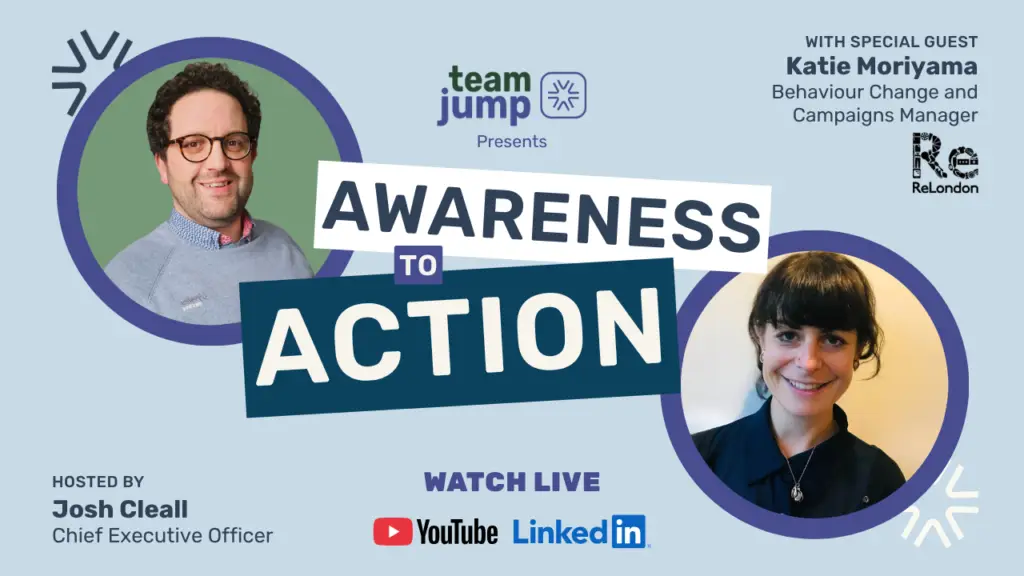


Sustainability in healthcare is a really hot topic right now as trusts rush to meet their net zero targets. sticks when staff see it as part of good patient care and link it to what they already care about. That was the clearest lesson from our latest Awareness to Action live stream, recorded with Guy’s and St Thomas’ NHS Foundation Trust.
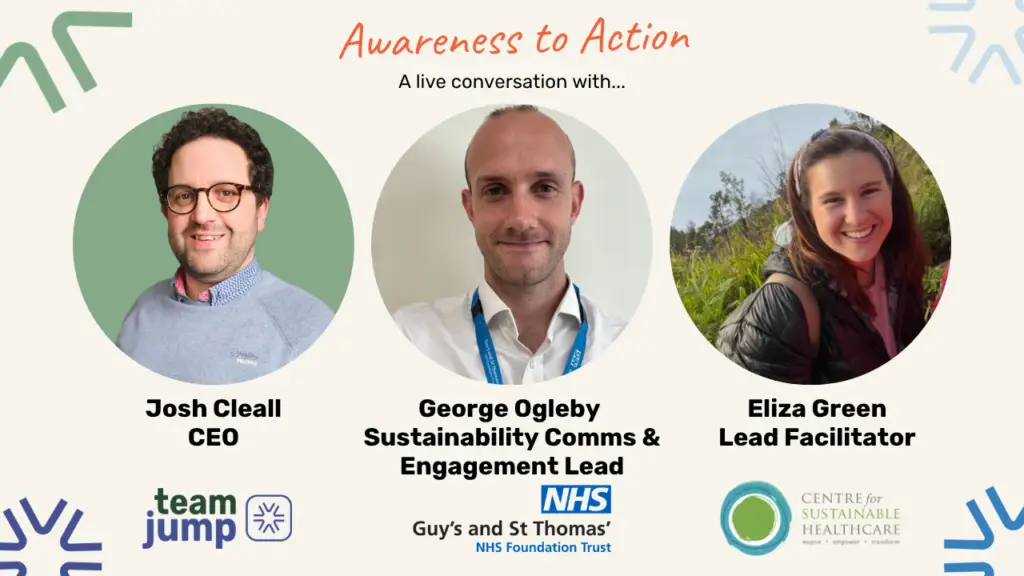
Our CEO, Josh Cleall, spoke to George Ogleby, Sustainability Engagement and Communications Lead at Guy’s and St Thomas’, and Eliza Green, an advanced orthoptist at the trust and one of its green champions. Eliza is also Lead Facilitator at the Centre for Sustainable Healthcare. Below, you’ll find their advice on running a green champions network, plus 6 practical steps for starting change in your own trust.
Key takeaways
- Staff act on sustainability when it links to patient care and to their own priorities, such as budgets or skin health.
- Guy’s and St Thomas’ asks new green champions about their interests and skills, then offers a menu of roles to match.
- Green champions agree 30 to 60 minutes a week of protected time with their line manager.
- The same campaign lands better when each staff group hears the reason that matters to them.
- Grassroots action and senior leadership both matter, so neither should carry the load alone.
- Start with one small project where data is easy to collect, then share the results.
Watch the full Awareness to Action live stream
Key moments:
- 0:48 George and Eliza introduce their roles
- 4:18 Turning staff who care into staff who act
- 7:46 Making green plan targets relevant on the ward
- 10:52 Why staff volunteer as green champions
- 14:32 Projects that overcome hospital barriers
- 18:14 Small actions with a large ripple effect
- 20:45 Top-down leadership and grassroots action
- 23:42 Making the case alongside patient care
- 27:31 The one practical step to take first
Sustainability in healthcare starts with patient care
Sustainability in healthcare gains support fastest when staff see it as part of their duty of care to patients. Eliza described this as making the connection between good healthcare and sustainable healthcare. Clinicians commit to doing no harm, and a health service that damages the environment can’t last in the long term.
The scale of the challenge is large. A 2019 report by Health Care Without Harm and Arup found that healthcare produces 4.4% of global net emissions. If the sector were a country, it would be the fifth-largest emitter. In England, the NHS aims to reach net zero by 2040 for the emissions it controls directly and by 2045 for the emissions it can influence (NHS England, Delivering a net zero NHS, 2020).
Most NHS staff already care about the climate. The harder step is turning that concern into action. Eliza said the answer is to find what each person values:
“The way that we can get them to actually go from caring about it to having actual change is by clicking into whatever their personal passions are.” Eliza Green (5:50)
For a manager who runs a department budget, that might mean showing long-term savings. For a primary care network, it might mean the social benefits for patients.
How Guy’s and St Thomas’ matches green champions to their skills
Green champions are one of the most practical ways to spread sustainability in healthcare across a large trust. George works across Guy’s and St Thomas’ and King’s College Hospital NHS Foundation Trust. Both are large organisations with a small sustainability team, so they rely on colleagues to lead change in their own areas.
When someone signs up as a green champion, they fill in a short form about their interests and experience. That might be recycling or active travel, for example. George’s team then offers a menu of options that fit.
“So I guess a bit of a matchmaking service for our green champions.” George Ogleby (7:04)
Eliza is a good example. Her form mentioned that she was a quality improvement (QI) facilitator, a skill the sustainability team didn’t have. She now gives QI support to other green champions and was due to give a trust-wide presentation on sustainable quality improvement (SusQI).
George keeps the role informal, because a long list of duties can put people off. Every activity still links back to the trust’s green plan. At the moment, green champions at Guy’s and St Thomas’ are:
- running stalls at hospital sites to talk to patients and visitors about the green plan
- working as a group on waste and recycling, and delivering training in their own areas
- leading wellbeing walks in nature on hospital sites
- sharing specialist skills, such as Eliza’s QI support
The role is voluntary, but George asks each applicant to agree 30 to 60 minutes a week of protected time with their line manager. That small commitment gives champions the space to act. Eliza added that many clinicians join because they feel isolated in their department. The support of the network gave her the confidence to bring her own team on board.
This matches what we see in Team Jump programmes with NHS trusts. Manchester University NHS Foundation Trust (MFT) reports more than 150 staff in its Sustainability Advocate programme, and our MFT case study explains how it keeps them involved. For a ready-made structure, our Green Champions Handbook covers roles, recruitment and support.
Tailor your sustainability message to each staff group
A single sustainability message rarely works for every staff group in a hospital, so Guy’s and St Thomas’ changes the reason it gives for each audience. George avoids technical jargon and sometimes doesn’t use the phrase “net zero” at all. He focuses on what matters most to staff, which is usually giving patients the best possible care.
The trust’s Gloves Off campaign shows how this works. Nurses hear that wearing gloves when they aren’t needed can feel impersonal for patients. Porters and food service assistants hear that unnecessary glove use can cause skin conditions such as dermatitis, which can stop them working as well as they’d like.
“I think it’s about finding those messages that resonate with different audiences and then sticking with them.” George Ogleby (9:29)
George also goes to staff rather than waiting for them to come to him. Some clinicians only have 30 minutes spare in a shift, and some housekeeping staff don’t use laptops at work. So his team attends meetings in people’s own areas, including evenings and weekends for shift workers. Our guide on how to engage busy employees in sustainability has more ideas for reaching people with little spare time.
Small actions with a big healthcare sustainability impact
Some of the largest gains in healthcare sustainability began as small projects led by a few clinicians. George pointed to desflurane, the anaesthetic gas with the highest global warming potential of its kind. He explained that it started with small clinical audits by anaesthetists about 10 years ago. That work grew until NHS England announced in January 2023 that routine use would end by early 2024 (The Pharmaceutical Journal, 2023). Clinicians had found alternatives that were safe and cheaper.
Eliza’s example was virtual and telephone consultations. They grew during the pandemic for other reasons, but many have stayed where they’re clinically appropriate. They save travel for staff and patients, and that cuts emissions the NHS usually struggles to influence.
She also recommended copying projects that already work. Eliza’s ophthalmology team is now spreading Operation TLC, a project from Barts Health that encourages staff to switch off lights and computer screens. It sounds simple, but the savings add up across many departments.
“There’s a lot to be said for not reinventing the wheel.” Eliza Green (9:43)
Why green champions need senior leaders too
Grassroots action and senior leadership both shape staff behaviour, and George and Eliza agreed that a trust needs both. George described a recent meeting where ICU nurses came together after the recent heatwaves to talk about their department’s impact. He said top-down communications could never achieve that kind of behaviour change on their own.
Leaders still have a big part to play, though. They set the tone through their decisions, such as approving protected time for green champions.
“We need to be careful not to push the responsibility down the hierarchy.” George Ogleby (22:30)
Guy’s and St Thomas’ is running net zero leadership training with the Centre for Sustainable Healthcare for some trust leaders.
Eliza also pointed to research on social tipping points. In a 2018 study published in Science, Damon Centola and colleagues found that a committed group of about 25% could change a group’s established norm. You don’t need everyone on board before change starts to spread.
How to make the case for sustainable healthcare
The strongest case for sustainable healthcare shows that a project improves care as well as cutting carbon. The Centre for Sustainable Healthcare calls this the triple bottom line, which weighs environmental, social and financial benefits together. Its principles of sustainable healthcare put prevention first, because care that isn’t needed has no carbon footprint.
George and Eliza shared these projects from Guy’s and St Thomas’:
- switching suitable patients from intravenous (IV) to oral antibiotics, which can shorten hospital stays and cut plastic waste
- the Gloves Off campaign, which improves the patient experience and protects staff skin
- Choose Wisely, Test Smartly, a campaign that asks clinicians to reduce unnecessary lab tests
- e-cargo bikes for nurses on home visits in Lambeth, which saved nurses time and gave them gentle exercise
Eliza’s advice is to avoid starting with a project that looks like a sacrifice. Pick one with clear benefits for patients and staff, then use its success to bring others on board.
How to start sustainability in healthcare at your trust
You can start sustainability in healthcare at your trust with one small, well-chosen project. These steps come from George and Eliza’s advice at the end of the live stream:
- Find your support. Read your trust’s green plan and contact the team behind it. Eliza also recommends free networks such as those run by the Centre for Sustainable Healthcare.
- Pick one project. Trying to do everything at once leads to burnout, Eliza warned.
- Choose an area with easy data. George said: “If you are going to identify those quick wins, do it in areas where you can easily access data to demonstrate impact.” (29:19)
- Give each group its own reason. Link the project to patient care or staff health, depending on who you’re talking to.
- Ask for protected time. Agree a set amount of time each week with line managers, as Guy’s and St Thomas’ does.
- Celebrate results. A shout-out in a team meeting or a post on a notice board builds confidence and brings more people in.
When you’re ready to track progress across a whole trust, measuring the impact of your programme makes those results easier to share.
The same steps work outside the NHS. University sustainability teams can match student and staff champions to their skills in the same way. Council climate teams can apply them to community champions, with each group hearing the local benefit that matters most to them.
Related reading
- Britain’s largest NHS trust: how MFT encourages employee climate action
- Net zero NHS: how trusts across England are engaging staff
- Practical advice for sustainability champions
- Carbon Literacy: turning awareness into action
Get a free review of your staff engagement plan
Book a free Sustainability Engagement Health Check to find the gaps in your trust’s plan for engaging staff. You can also see how we work with NHS trusts and their staff.