

Student energy saving works at Durham University because the team promotes its app constantly and gives people reasons to act beyond the climate. College rivalry, monthly prizes, lower bills and time outdoors all bring in students who would ignore a standard switch-off poster. The money case is real: students in Save the Student’s National Student Accommodation Survey 2026 spent an average of £83 a month on energy.
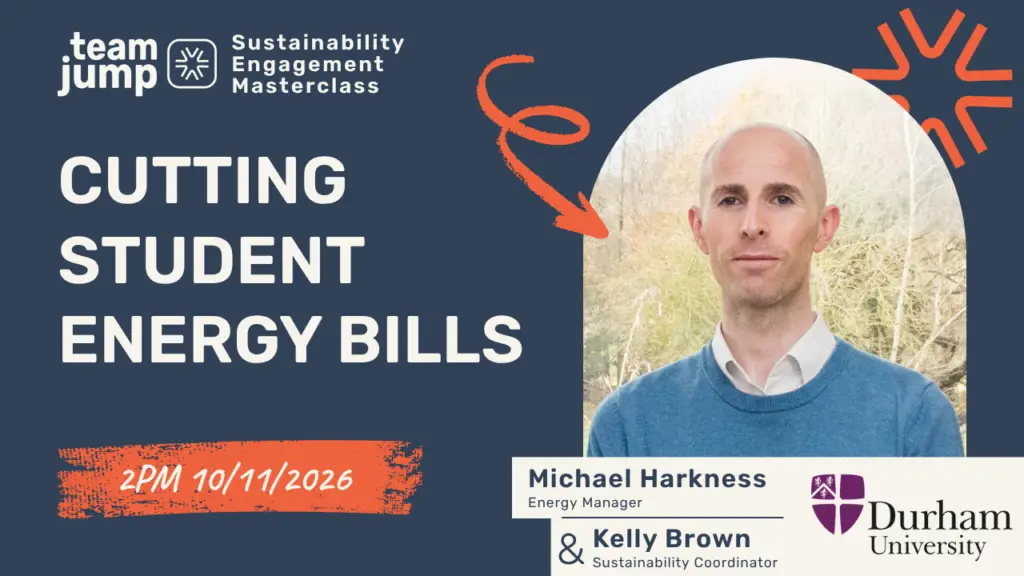
In our latest Sustainability Engagement Masterclass, Team Jump CEO Josh Cleall spoke with 2 guests from Durham University. Michael Harkness is Energy Manager and Kelly Brown is Sustainability Coordinator. They explained how Durham pairs building upgrades with its My Greenspace engagement programme, and shared the lessons other universities can copy.
Watch the full Durham University masterclass
Key moments:
- 0:08 Josh Cleall introduces the session and the cost of student energy bills
- 8:42 Michael Hartness on Durham’s estate and net zero target
- 12:47 How automatic meter reading finds waste and leaks
- 14:14 Inside the My Greenspace app
- 18:15 Kelly Brown on Durham’s events calendar and new energy tasks
- 22:35 The Piggy Bank Challenge
- 27:52 Promoting the app as students come and go
- 31:33 College competitions and the varsity cup
- 34:39 Engaging students in very different buildings
- 42:15 Turning meter data into action with exception alerts
- 45:34 Reaching the 80% through wellbeing
- 50:20 Advice for universities starting out
Why student energy saving needs people as well as buildings
Student energy saving needs engagement because even the best building upgrades can’t control how people use heating and electrical equipment. Durham has around 20,000 students and more than 350 buildings. They range from energy-intensive science labs to student rooms in a Norman castle on a UNESCO World Heritage Site. The university has a target to reach net zero by 2035.
Michael described the technical work so far:
- heating buildings to 19°C
- upgrading building management systems and optimising controls
- replacing gas boilers with air source heat pumps in refurbished buildings, plus solar panels
- installing automatic meter reading (AMR) for electricity, gas and water, which has helped the team find leaks
Technology leaves a gap, though. Durham has 17 colleges, and Kelly explained that each building seems to run a different heating system. Some students can turn radiators down and others live with a set temperature. Events about biodiversity are easy to organise, but energy and water are harder to bring to life. Kelly said the app helps: “So the platform is actually quite useful in engaging students and staff in energy saving and water saving.”
Durham also asks students what stops them saving energy. At the castle, students couldn’t turn their radiators down. The university found funding to fit thermostatic valves, so residents now have more control.
How the My Greenspace app turns energy saving into a habit
My Greenspace is Durham’s branded version of the Team Jump app, where students and staff log small sustainable actions all year. Team Jump is a UK sustainability engagement company. We design and run custom, gamified behaviour change programmes that help organisations build sustainable habits into their people’s routines.
Almost 1,700 students and almost 900 staff use the My Greenspace app. People earn points for each action they log, which gives them the chance to win a gift voucher every month. You can read more in our Durham University case study.
Several features support energy saving in particular:
- Photo tasks. A new switch-off task asks people to upload photos of themselves switching things off, such as lights and computers. Another asks students to turn down their boilers.
- Tailored tasks. Michael recently wrote a new energy management plan, and Kelly had tasks added to the app to support it.
- Monthly themes. Last month’s actions included a net zero Halloween theme.
- Short learning. The Greenspace Climate Classroom offers modules of about 10 minutes, each worth points. This is Durham’s version of our bite-sized sustainability eLearning.
Photos and posts appear in a shared community feed. Josh pointed out that this works as social proof, because people see their peers taking action.
Keep promoting the app, because students move on every year
The biggest lesson from Durham is that sign-ups and activity depend on constant promotion. “We lose a third of our student population every year if not more,” Kelly said. Some first years leave before Christmas, and a third of students graduate each summer.
Durham’s team posts on social media once or twice a day, and every post links back to the app. Kelly also uses the app itself, digital screens in teaching buildings, weekly college newsletters and a central Friday newsletter for all students and staff. Students who live out still get the same messages through their college. Her summary was simple: “the success of it depends on how much you can promote it really.”
Josh said the same pattern shows up across Team Jump’s university programmes. Signing people up early, ideally at freshers, gives them the most time to earn points and climb the leaderboard. Staff move on too, so staff promotion needs the same rhythm.
Kelly’s advice is to test every channel and keep what works. “I would try everything and then drop what doesn’t work,” she said. Her students now tend to use Instagram to find events rather than to socialise, which she only learned by asking them.
College competitions make student energy saving social
Friendly competition between Durham’s 17 colleges is one of its strongest engagement tools. With Team Jump’s support, Kelly runs an annual varsity cup each February and March. Colleges compete to log the most sustainable actions on the app. Each week focuses on a theme, such as energy or waste and recycling.
The timing is deliberate. Kelly finds that new students are flooded with information at the start of the year. By the second term they have settled in and are more open to joining a competition. “A little bit of healthy competition seems to work quite well, actually,” she said.
Other universities use the structures they already have. Josh mentioned academic departments and professional services units competing against each other, and Durham is now exploring department teams for staff. Our page on how gamification works in a Team Jump programme explains how points and leaderboards work for teams.
Link student energy saving to lower bills
Saving energy saves students money, so a cost-of-living message can reach people who don’t respond to climate messages. Team Jump’s Piggy Bank Challenge focuses on 4 behaviours that cut costs and environmental impact:
- bringing your own reusable cup or water bottle
- car sharing
- avoiding buying new, for example through second-hand apps
- reducing food waste with shopping lists, portion control, better use of the freezer and eating all parts of a vegetable
The campaign runs for a limited time, with badges and a progress thermometer for each institution. We challenge every programme to save its members a collective £10,000. Josh said 80% of our university clients are taking part, along with other clients such as NHS trusts and councils. By the time of the masterclass, members had logged more than 4,000 actions and earned over 500,000 points. Josh estimated that they had already avoided 3 tonnes of food waste. Points like these can count towards rewards for sustainable actions, such as vouchers.
Reach the 80% through wellbeing and student-led action
Kelly sees Durham’s students in 3 broad groups, and the largest one is the easiest to miss. “I always think that we have 10% of students who are what I would call our people,” she said. Another 10% will never be interested, which she accepts. The remaining 80% believe it doesn’t apply to them, yet many already buy second-hand clothes and make other sustainable choices. “They just don’t realise it,” Kelly said.
Wellbeing is how Durham reaches that 80%. Outdoor volunteering, such as digging a pond, attracts students who want a break or some experience for their CV. Sign-ups rise around exams, when students and staff want time outdoors. Kelly now works with Durham’s wellbeing and student support teams: she organises the events and they promote them to their own audiences.
Volunteers can log their hours on the app as well as on the university’s volunteering platform. Kelly tells students that winning a voucher is easier than they think, and new names now reach the leaderboard every month.
Student groups matter too. Second-hand clothing sales only took off when student groups ran them and the university helped promote them. Michael’s advice was to “give them that ownership and see how that goes.”
How to apply Durham’s student energy saving lessons
You can apply Durham’s approach to student energy saving without a castle or a college system. These steps work for most universities:
- Ask about barriers first. Find out what people can and can’t control in their building before you write any messages.
- Promote constantly. Link every post and newsletter back to your programme, and plan a fresh push for each new intake.
- Use the teams you already have. Halls, colleges, departments and student societies all make natural competition teams.
- Offer personal reasons to act. Saving money and time outdoors reach people who aren’t motivated by carbon.
- Share the work with partners. Wellbeing teams, student support staff, the students’ union and student groups can promote your activities to their own audiences.
- Use your meter data. Michael uses exception alerts that flag high or overnight use. As he put it, “data is fantastic but you need to be able to use it as well.” Sharing results with people shows them the effect of their actions.
The same model works beyond campus. Councils can run energy saving challenges for residents, with neighbourhoods as teams and household bills as the hook (see our programmes for residents). NHS trusts can use wards or departments as teams. Businesses can use sites and pair switch-off reminders with out-of-hours meter data.
Related reading
- How the University of Manchester Built Their Sustainability Champions Network
- Sustainability Champions on Campus
- Sustainability Rewards: Empowering Student Climate Action
- Why One-Off Sustainability Campaigns Fail to Build Climate Action Momentum
Find the gaps in your student engagement plan
Book a free Sustainability Engagement Health Check and our engagement experts will show you where your energy saving and engagement plans could reach more students and staff. For ideas on recruiting student volunteers, download the Student Champion’s Handbook.