

Central London Community Healthcare NHS Trust (CLCH) and West London NHS Trust built a green champions network of around 240 staff by meeting teams in person and asking very little of each new recruit. The harder task, as both trusts have found, is turning those sign-ups into colleagues who act.
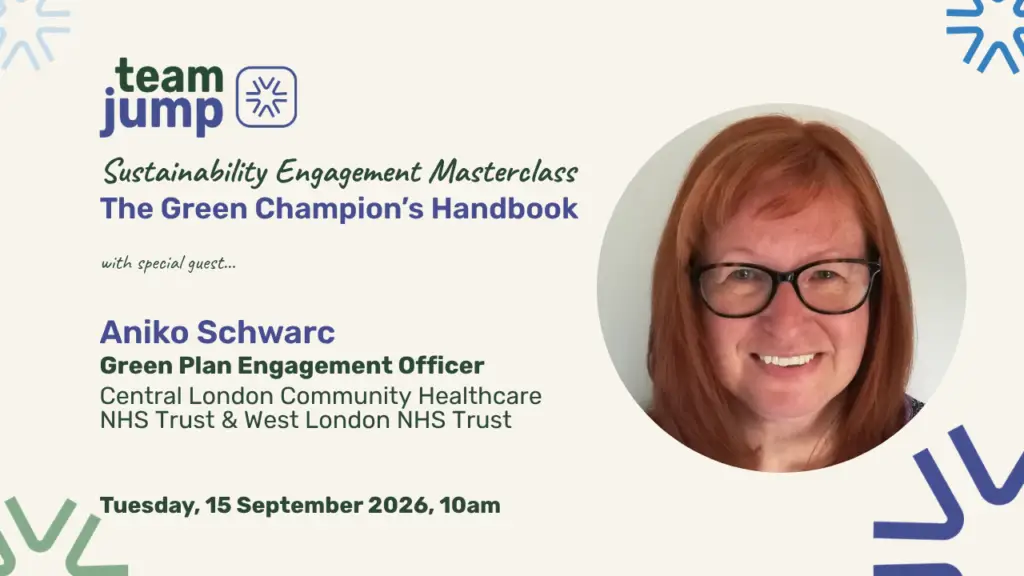
At our Sustainability Engagement Masterclass on Tuesday 15 September 2026, Aniko Schwarc shared how she recruits and supports champions across both trusts. Aniko is the Green Plan Engagement Officer for the sustainability partnership between CLCH and West London NHS Trust. Rob Marsh, Client Success Director at Team Jump, the UK sustainability engagement company, hosted the session, which also launched our free Green Champions Handbook. This recap sets out what worked for Aniko, along with steps you can use in your own organisation.
Key takeaways
- A green champions network of about 240 members supports a shared sustainability team of just 8 people across 2 NHS community trusts.
- Face-to-face talks at team meetings and events recruit far more champions than newsletters or intranet posts.
- Champions pick how involved they get, from reading and sharing updates up to running local projects.
- Aniko is clear that 240 members doesn’t mean 240 active champions, so she measures success by action.
- The lack of protected time is the biggest barrier, especially for clinical staff who can’t step away from patient schedules.
- The trusts’ staff engagement app, Sprout, reaches colleagues who will never join a formal network.
Watch the full masterclass
The recording covers Aniko’s presentation, followed by a Q&A with Rob. Topics include:
- how the 2 trusts work and why they need champions
- recruitment methods and leadership support
- engagement tactics and champion projects, including Sprout
- the barriers and Aniko’s lessons
- questions on champion traits, clinical staff, meeting topics, measuring impact and burnout
What is a green champions network?
A green champions network is a group of staff volunteers who share sustainability ideas with colleagues and help their organisation put its plans into practice. In the NHS, every trust must have a Green Plan (West London NHS Trust, 2025). Each plan supports the national targets in Delivering a net zero NHS (NHS England, 2020): net zero by 2040 for emissions the NHS controls directly, and by 2045 for emissions it can influence. For more on the role itself, read our guide to what sustainability champions do.
Champions matter most when a central team is small and staff are spread out. CLCH and West London formed their sustainability partnership in July 2023 and share a team of 8. CLCH provides mainly physical health services across 11 London boroughs and Hertfordshire. West London NHS Trust provides mental health services, mostly in 3 West London boroughs, and runs Broadmoor, a high secure hospital in Berkshire.
Many staff visit patients at home, and some work in secure units where they can’t use their phones. A team of 8 can’t reach all of them. “Without them, I would personally feel very lost by now after running the network for such a long time,” says Aniko.
The network grew in 2 stages. CLCH set up its network in October 2020, and West London started one more recently. The trusts then merged the 2 networks, which now hold about 170 champions at CLCH and about 70 at West London.
How CLCH and West London recruited 240 green champions
Face-to-face contact recruits the most green champions at both trusts, even though written communications reach more people on paper. Aniko’s team still uses news items, the staff newsletter, intranet pages and posters. A Microsoft Forms sign-up also means anyone interested can join quickly.
Targeted presentations to teams and services work much better, in person or online. Aniko’s other recruitment tactics include:
- running stalls at events, with a QR code so people can sign up on the spot
- speaking at other staff networks’ events, such as a talk for the Women’s Network on how climate change affects women
- taking a stall at the annual general meeting, which she calls “unbelievably helpful compared with just working from a back room”
- relying on enthusiastic champions to bring their colleagues in
Leadership support makes recruitment much easier. Sustainability sits in CLCH’s 5-year strategy, so Aniko can point to it, and both trusts report on their Green Plans at board level. Senior leaders also help win over local clinical teams. As Aniko put it, “the medical director can influence the clinical teams.”
If you don’t have that support yet, Rob suggests finding an executive sponsor. This senior leader can back the network’s bigger ideas where decisions get made.
People also need a reason to join. Aniko’s team explains why the Green Plan exists, then reassures busy staff that they can be green champions “without too much expectation from us”.
Keeping green champions involved without protected time
Champions at CLCH and West London stay involved because the network asks for little and gives them plenty to dip into. The team runs:
- network meetings every 6 weeks with guest speakers, on varying days and at varying times, and records them for anyone who can’t attend
- a monthly newsletter with a theme, colleague profiles, news and resources
- a 1-hour in-house training module on sustainability in healthcare, open to all staff, face to face or online
- recognition through a green category in CLCH’s staff awards, with plans for one at West London
Popular meetings have included a session from a green engagement specialist and the launch of the gloves off campaign. A West London champion also spoke about food on bedded wards, and another champion talked about her vegan diet.
Champions choose their own level. Level 1 champions come for information and pass it on. Those at level 2 want to run projects, so the team advises them and links them with the right services, without doing the work for them.
What green champions do at the 2 trusts
Green champion projects range from a quick word at a team meeting to a brand-new garden. Examples Aniko shared include:
- turning an empty courtyard at Glenthorne Road Health Centre, which sees mental health patients, into a garden
- litter picks, plus active travel promotion that encourages colleagues to leave the car at home
- the gloves off campaign and stock checks to cut waste and plastics
- making blankets from crisp packets for a homeless charity
- small local changes, such as better bin use, less printing, less meat, and gardening or walking groups
West London NHS Trust reports that its sustainability group of over 70 staff helped lead a campaign that cut glove use by 15%, equivalent to 125,000 gloves (West London NHS Trust, 2026).
Small actions count too. “So even if you make your admin not to order virgin paper anymore, just change to recycled paper, then you already achieved something with that,” Aniko says.
How Sprout extends the network’s reach
Sprout is the staff engagement app powered by Team Jump for both trusts. It launched in October 2025 and is open to every member of staff, because not everyone wants to be a champion. Aniko’s team promotes it alongside the network, with separate leaflets at stalls.
Staff earn points for logging actions and reading learning content. Aniko says that because of the gamification and rewards, “we think this is a more fun way to engage people in the green agenda rather than just sending out articles to read.” Champions use it as a talking point too. One shares Sprout’s weekly reminder with his team, then discusses green topics at their team meeting. You can see how gamification works in a Team Jump programme.
Why 240 members isn’t the same as 240 active champions
Membership numbers overstate how active a green champions network is, and Aniko is candid about the gap. “We have to be realistic that just by having 240 members, it doesn’t mean we have 240 active green champions,” she says.
Many attendees will recognise this. In our live poll, every attendee who voted already had a champions network, and votes on how well those networks work split evenly.
The main reasons Aniko gave are:
- no protected time, so many champions can’t attend meetings unless a manager backs their project
- a spread of sites too wide for a team of 8 to visit regularly
- members who never respond, and low response rates to surveys
- people who join to raise a grievance, such as a poor bike route, rather than to take part
- good ideas held up by funding gaps or by landlords who won’t agree to site changes
- staff turnover, which means the team keeps replacing leavers
The network has slightly more corporate staff than clinical staff, and the mix varies by site. Corporate staff can add a meeting to their calendar, while clinical staff follow patient schedules they can’t break. So Aniko adapts the message. For corporate teams that means printing and stock orders. Clinical teams relate more to dressings, medication, home visits and travel between sites.
Measuring impact is the gap Aniko most wants to close. The team tracks membership and meeting attendance, but it can’t see how many people read its PDF newsletter or intranet news. She has asked the trusts’ communications team for data. Rob suggested marking champions within Sprout, so the team could see their actions separately. Our guide to measuring the impact of your programme shows the kind of data an app can add.
Aniko hasn’t yet addressed champion burnout directly. She plans to cover it in a future network meeting, and possibly in a joint webinar for all staff at both trusts.
Lessons for running a green champions network
Aniko’s main lesson is to judge the network by what champions do. “We can measure success only by action and not by just the number of the green champions,” she says. Her other advice:
- Don’t scaremonger. People are tired of harsh climate messages, so respect their time and routines.
- Make it local. “The polar bear on the sheet of ice is not always the best example because that’s not relatable,” she says. Food waste, for example, lands better through home life, because community trusts do little cooking.
- Keep it flexible. Don’t push champions to attend meetings or take on projects.
- Give champions practical tools, then advise rather than taking over.
- Invite active champions to speak at trust forums, which gives them public credit.
- Ask champions for feedback on the network itself.
- Accept “satellite” champions. In Aniko’s words, “not everyone who is a green champion wants to be in a formal network”, and that’s fine.
She closed with a reminder: “If you have a green champions network, they will definitely help you to multiply the reach … but the network needs continuous investment.”
How to start or improve your green champions network
These steps adapt Aniko’s approach for any organisation. Our Green Champions Handbook covers each area in more depth, with tips from beginner to expert level. Its worksheet also lets champions set SMART goals for their climate action on screen.
- Write down why the network exists, and link it to a plan your leaders already back.
- Recruit in person first, at team meetings and other staff networks’ events.
- Offer 2 levels of commitment, so people can join without taking on a project.
- Hold short meetings at different times and record them for anyone who misses out.
- Give champions ready-made actions they can take locally, plus advice when they want to go further.
- Offer everyone else a way in, such as an app or campaign, so the network isn’t your only channel.
- Track actions from the start, as well as membership.
The details change by sector:
- NHS trusts: plan around clinical rotas, and ask a medical or nursing director to back the network. Our programmes for NHS and workplace staff show how an app can sit alongside it.
- Universities: recruit at freshers’ fairs and in halls, and expect to rebuild part of the network every academic year. The Student Champion’s Handbook is written for student volunteers.
- Councils: recruit community champions through residents’ groups and local events, and link their work to your climate action plan.
- Businesses: run sessions that hybrid and site-based teams can join, and give each green team its own local goals.
Related reading
- How The University of Manchester built its sustainability champions network
- How NHS trusts across England are engaging staff in net zero
- How MFT, Britain’s largest NHS trust, encourages staff climate action
- How to engage busy employees in sustainability
Find the gaps in your engagement plan
Book a free Sustainability Engagement Health Check to see where your champions network and wider engagement plan could do more. It’s a 30-minute call with our team, followed by a 2-page scorecard with tailored recommendations. You can also download the Green Champions Handbook to give your champions structure from day one.