

Student wellbeing activities give sustainability teams a dependable way into climate action, because they start with something students already want. At Anglia Ruskin University (ARU), wellbeing actions such as outdoor breaks make up around 25% of everything logged on ARU Green.
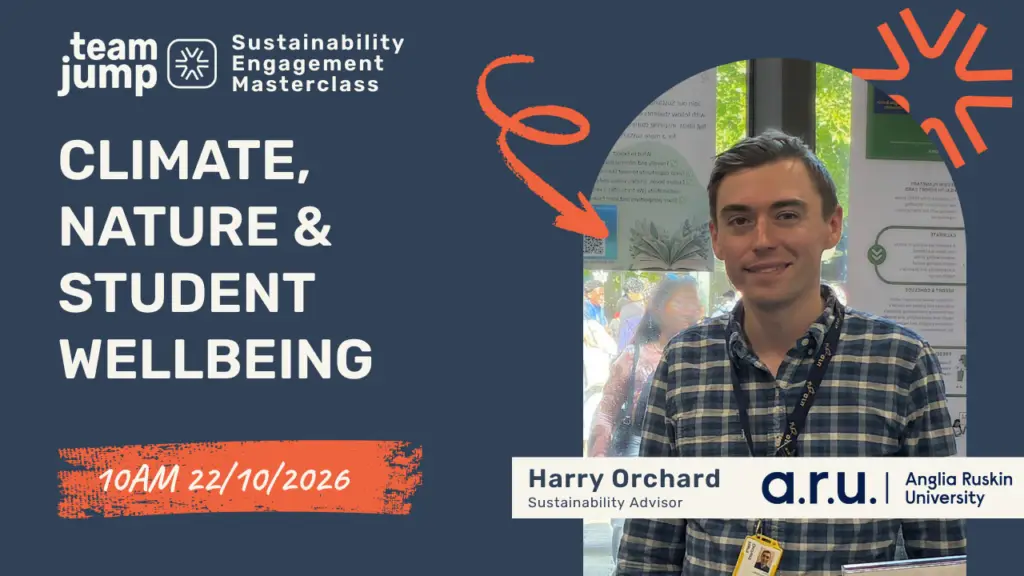
In our latest Sustainability Engagement Masterclass, Harry Orchard, Sustainability Advisor at ARU, explained how his team of 3 reaches around 37,000 students. Nature and wellbeing are their way in. Kay Alatishe, Client Success Manager at Team Jump, hosted the session. Below you’ll find the activities ARU runs and steps to adapt them for your own campus.
Watch the full masterclass
The session ran on Tuesday the 22nd October 2026. Some key moments include:
- Kay’s overview of Team Jump programmes at other universities
- Harry on ARU’s campuses and the pressures students face
- The four E’s framework and ARU’s 10 communication principles
- ARU Green’s wellbeing activities and results
- The Cambridge growing plot and the biodiversity photo competition
- Audience questions on eco-anxiety and measuring impact
Key takeaways
- Around 70,000 wellbeing actions have been logged on ARU Green, roughly a quarter of all actions on the platform.
- Nature and biodiversity are almost always the first topics students name when ARU asks what interests them at welcome week.
- ARU pairs each green behaviour with a personal benefit, such as better health or lower travel costs.
- A biodiversity photo competition each April gets students outdoors before exams, with winners chosen by a community vote.
- Our team signed up over 150 new ARU Green members at ARU’s freshers fairs in Chelmsford and Cambridge.
Why student wellbeing activities work for climate action
Student wellbeing activities work for climate action because they give students a personal reason to take part. Harry described students who juggle lectures, assignments, part-time work and the rising cost of living. Against that list, sustainability can feel like one more demand.
Many students also feel anxious about climate change and unsure their actions count. Every attendee who answered our poll during the masterclass said they had seen climate anxiety rise among students. A 2021 global survey in The Lancet Planetary Health points the same way. It asked 10,000 people aged 16 to 25 in 10 countries, including the UK. Nearly 6 in 10 were very or extremely worried about climate change. Almost half (45%) said these feelings affected their daily lives.
Harry’s answer is to lead with benefits students feel straight away. “Wellbeing can be a powerful gateway to sustainability engagement,” he said. Health and money often feel more immediate than carbon figures, so ARU puts them first. Harry has also found that seeing thousands of small actions add up gives students a sense of agency and helps ease eco-anxiety.
How ARU links green behaviours to personal benefits
ARU links each sustainable behaviour to a personal benefit through a communications and engagement framework based on the four E’s model. The model comes from the UK Government’s 2005 sustainable development strategy, Securing the Future. It recognises that information alone rarely changes behaviour. People also need to be enabled, encouraged, engaged and shown good examples.
The framework includes 10 principles for sustainability communications. Principle 3 links environmental behaviour to positive aspirations, such as self-improvement, better wellbeing, connection to green spaces and pride in the university. For each theme, ARU sets the behaviours it wants and a few key messages. This table shows the personal benefits it leads with.
| Sustainability theme | Personal benefit ARU highlights |
|---|---|
| Biodiversity | Spending time in nature benefits physical and mental wellbeing |
| Energy | Energy efficiency makes campus buildings and student accommodation more comfortable |
| Active travel | Walking and cycling can be more fun and improve your health |
| Car sharing and public transport | Sustainable travel options can often cut costs |
Each message uses a motivation people already have, so sustainability doesn’t add to a full week.
Reaching students across 4 campuses with a team of 3
ARU reaches students mainly through digital engagement, because in-person events are hard to run consistently across its campuses. Its campuses in Cambridge, Chelmsford, Peterborough and Writtle each have their own community, with little mixing between them. A growing share of students also commute, so they spend less time on site.
That is why ARU has worked with Team Jump on ARU Green for several years. Team Jump, the UK sustainability engagement company, designs and runs gamified behaviour change programmes for universities and other organisations. ARU Green has about 2,000 members, split roughly evenly between staff and students.
ARU can’t email students about sustainability without their permission, but ARU Green members get programme emails for each campaign. Harry finds the university’s own app works best for students, because they use it every day. For staff, newsletters work best.
Face-to-face contact still helps. Three of our team visited ARU’s freshers fairs in Chelmsford and Cambridge. With help from a lucky wheel and chocolates, they signed up over 150 new ARU Green members. “The real value comes from… the conversations that you’re able to have face to face with people,” said Kay. Our guide to connecting with people at in-person sustainability events has more ideas.
The wellbeing activities ARU Green rewards
ARU Green rewards students and staff with points and voucher prizes for nature and wellbeing activities, alongside energy and travel actions. The wellbeing activities include:
- taking outdoor breaks and walking around campus
- following biodiversity trails on the Cambridge and Chelmsford campuses
- a step challenge that links to Fitbit and Strava, so steps feed in automatically
- growing fruit and vegetables at home, with photos shared on the activity feed
Every activity works wherever a student lives, which matters for commuters. The activity feed also makes sustainable behaviour visible, so others want to join in.
ARU chose a high number of wellbeing activities on purpose. That way, people with little interest in sustainability still find several that suit them. Once they earn a few hundred points a month, a voucher feels close. They may then branch into travel or energy actions too.
The numbers show the appeal. About 70,000 wellbeing actions have been completed on ARU Green, around 25% of all actions on the platform. The step challenge alone makes up roughly 20% to 30% of activity in the health and wellbeing theme.
ARU also promotes national citizen science campaigns, such as the RSPB’s Big Garden Birdwatch and Butterfly Conservation’s Big Butterfly Count. Meanwhile, Climate Classroom, Team Jump’s bite-sized climate learning, means the team writes less educational content of its own.
Partnerships that run nature activities for you
Student wellbeing activities don’t have to come from the sustainability team, as ARU’s growing project shows. On the dense Cambridge campus, the Student Sustainability Society asked for space to grow food. The landscape manager allocated a plot of about 12 square metres outside an accommodation block. The lead science technician also gave students access to the campus greenhouses.
At the same time, a local charity, Earth and Mind, approached ARU to run wellbeing sessions for students. Working with the wellbeing team, the charity ran weekly sessions on the same plot. The space was used several times a week and looked after through the academic year. Because the wellbeing team owned the sessions, Harry’s team spent little time on them and gained another route to promote ARU Green.
“What I particularly liked about this project is that it wasn’t something that we had to try and deliver,” Harry said. His team’s role was largely to “connect the dots”.
ARU has run other nature activities in the same way. During one Earth Month, students from Chelmsford and Writtle planted trees with the Wilderness Foundation. Others went foraging in Cambridge’s green spaces. ARU promoted both with a wellbeing focus, which helped engagement.
How to run a biodiversity photo competition for students
ARU’s biodiversity photo competition is one of its most successful campaigns, keeping sustainability in student and staff communications for almost a month. Students and staff photograph wildlife they find outdoors and upload the pictures to an activity on ARU Green. Here’s how ARU runs it:
- Pick the right month. ARU runs it in April in most years. Spring is good for wildlife, and it falls just before exams, when a break outside helps with stress.
- Keep it low pressure. There is no strict theme, only a suggestion for inspiration.
- Promote the benefits of being outdoors. Wellbeing messages appear across ARU’s channels throughout the campaign.
- Let the community judge. ARU Green users vote for their favourites over a couple of weeks after entries close.
- Celebrate everyday nature. Some of the most popular photos show a weed growing through an urban footpath.
Harry said the competition also gets more attention from senior management because of its wellbeing link. “It reminds us that connecting with nature doesn’t have to involve travelling somewhere special, it’s all around us,” he said.
Research backs the idea that regular time outdoors adds up. A 2019 University of Exeter study in Scientific Reports looked at nearly 20,000 people in England. It linked at least 120 minutes a week in nature with better self-reported health and wellbeing. One long visit or several short ones worked equally well.
Measuring the impact of student wellbeing activities
ARU measures its student wellbeing activities by combining several data sources, because no single survey shows the full effect. Its engagement framework has a measures column for each theme. The sources include:
- student experience surveys
- ARU Green surveys on how members feel about the platform and its activities
- feedback from winners of sustainability vouchers
- wider data such as the National Student Survey (NSS)
Harry admits that, without asking the question directly, you won’t know exactly how much one activity improves wellbeing. Popularity on the platform is still a useful signal, and you can share it with your wellbeing team to plan joint events. ARU’s own analysis of carbon savings also found that encouraging behaviour change through ARU Green costs less than offsetting.
Social proof helps with harder behaviours such as travel. ARU shares figures on journeys made by public transport instead of car, so students feel “everyone else is doing it. I can do it too,” as Harry put it. Travel surveys on ARU Green, with prizes for taking part, also give ARU data to share with transport providers and local authorities.
How to apply student wellbeing activities on your campus
You can adapt ARU’s approach with a small team by starting from what your audience already cares about. These steps work for most universities:
- Ask students at welcome events which topics interest them, then lead with the answer.
- Write a personal benefit message for each behaviour you want, such as better health or saving money.
- Add enough wellbeing activities that people with no interest in sustainability still find several to log.
- Say yes to student groups and local charities that approach you, and connect them with colleagues.
- Time campaigns around the academic year, such as an outdoor challenge before exams.
- Track which activities are popular and share the results with your wellbeing team.
Nature activities should complement your university’s wellbeing and mental health services, never replace them, so signpost those services in your campaign messages. Our page for universities and students shows how this works on other campuses. You can also read how The University of Edinburgh rewards student climate action.
The same ideas work outside universities:
- Councils can reward residents for joining citizen science counts or visiting local green spaces. See how we engage residents.
- NHS trusts and businesses can offer step challenges and outdoor break activities that fit around shifts and hybrid working. See our programmes for employees.
Related reading
- Sustainability champions on campus
- How The University of Manchester built its sustainability champions network
- Urban greening in action with Trees for Cities
- Sustainability Engagement Trends 2026 report
Book a free Sustainability Engagement Health Check to find the gaps in your student engagement plan. It starts with a 30-minute call, and you’ll get a 2-page scorecard with practical next steps. If you’re building a student volunteer team, our Student Champion’s Handbook is a good place to start.