

A recycling campaign changes behaviour when it removes the practical barriers people face and offers them something they value, rather than relying on awareness alone. Posters and adverts help, but most residents only act once the bin is easy to use and they trust the council to do its part.
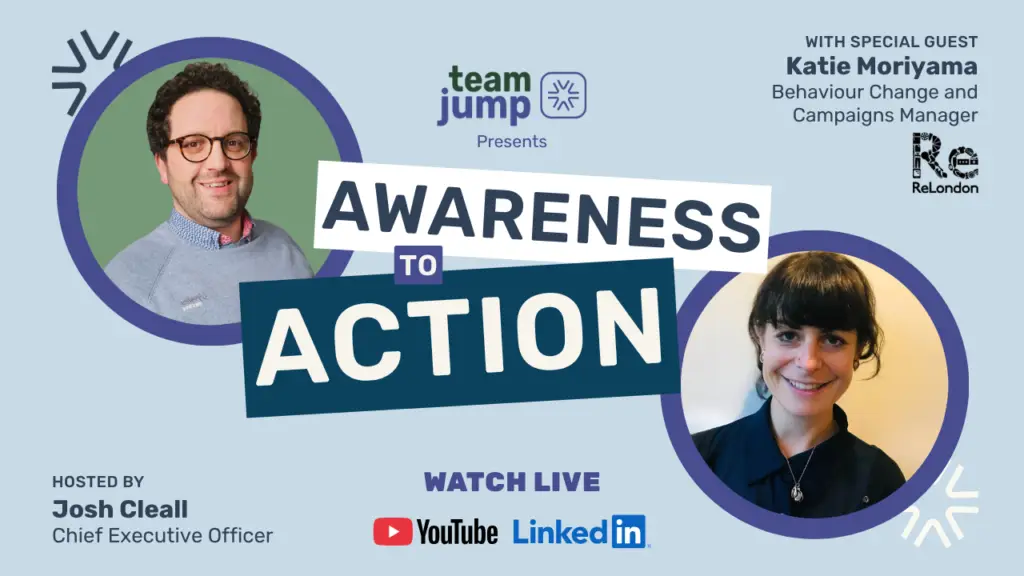
Katie Moriyama, Behaviour Change and Campaign Manager at ReLondon, shared that view when she joined our CEO, Josh Cleall, for an Awareness to Action live on 13 October 2026. ReLondon is a partnership of the Mayor of London and the London boroughs that works to improve waste and resource management in the capital. This recap covers her advice on diagnosing problems, designing for different motivations, building trust and measuring results.
Key takeaways
- Diagnose the problem before you plan communications, because the barrier often sits in the bin store rather than in what residents know.
- People in similar homes on similar incomes can have very different motivations, so research them in depth.
- Residents act when they trust the council to keep its side of the deal.
- Simple prompts often beat big campaigns, and “no food” bin stickers have raised food waste collections in UK trials.
- Measure behaviour as well as reach by pairing a theory of change with survey and bin data.
What makes a recycling campaign change behaviour?
A recycling campaign changes behaviour when it starts with a clear diagnosis of what stops people recycling, which is often a practical problem rather than a gap in knowledge. Katie said partners sometimes ask ReLondon for a big awareness push, when part of the answer lies elsewhere.
“There might be other things in the wider system that need to be solved before we jump into a comms campaign.” Katie Moriyama, ReLondon
One ReLondon project with several boroughs introduced food waste recycling to flats above shops, where residents must put waste out on the street at set times. Katie admitted she never recycled when she lived above a chip shop, because she had no idea where it was supposed to go. The project worked best where new bins and a cleaner street made residents feel they were getting something. In her words, it was like “a fresh start”.
At Team Jump, the UK sustainability engagement company, our own programmes began in flats in the London Borough of Bexley. Josh recalled the same barriers there, from cramped kitchens to bin stores that felt far away and unpleasant.
Recycling campaigns that reach different motivations
Recycling campaigns reach more people when they reflect what different residents care about, because people with similar lives can have very different reasons to act. To uncover those reasons, ReLondon has asked residents in flats to keep video diaries of how they deal with waste, which shows barriers people rarely mention in a focus group.
Local priorities matter too. In Tower Hamlets, ReLondon found that residents cared most about clean streets and linked that to recycling. Love Not Landfill, ReLondon’s clothing campaign for young Londoners, responded to loneliness among young people new to the capital with events where they learned to mend clothes and made friends. Katie said the campaign began in 2017 and has helped make second-hand shopping feel normal.
“I think some of the biggest wins are about shifting norms over time.” Katie Moriyama, ReLondon
Rewards work for some people and not for others. Josh explained that points tap into the instinct to collect, which is why they sit at the heart of our rewards for sustainable actions. Katie’s son and husband love the streaks in a language-learning app, while she and her daughter respond better to reasons linked to people.
“Everyone has different motivations and some of those are emotional rather than practical things.” Katie Moriyama, ReLondon
Trust closes the awareness to action gap
The gap between knowing and doing closes faster when residents trust their council to keep its side of the deal. Katie said most people agree with recycling in principle, but short-term barriers such as fly-tipping change what they actually do. This is often called the attitude behaviour gap.
Katie pointed to Hounslow Council, whose recycling rate she recalled rising by around 25% the last time rates were measured. Alongside new food waste collections, it added more mega skip days so people could get rid of bulky items without fly-tipping. It also promoted a helpline that would answer within 7 rings, with a clear message that the council was on residents’ side.
“Trust and competence are those basic things that need to be in place before anything else can happen.” Katie Moriyama, ReLondon
Small changes that make a recycling campaign work
The most surprising results in a recycling campaign often come from simple interventions that ask little of people and give them something back. Katie’s favourite example is a caution-style sticker on the rubbish bin saying that no food goes in it.
“The results are stunning… It’s just a sticker that says no food in here.” Katie Moriyama, ReLondon
Trials support this. In a 2026 trial with South Ayrshire Council, Zero Waste Scotland found that “no food waste” stickers on rubbish bins increased the food waste collected by 42%, well ahead of free caddy liners (14.4%). For more examples, read our guide to nudge theory and waste reduction.
Katie’s second surprise came from the UK’s first electrical repair voucher scheme, which ReLondon ran with The Restart Project and North London Waste Authority. One university freshers fair led to a sharp rise in applications, because students heard the right offer at the right time. The Restart Project’s evaluation reports more than 4,000 applications and 1,254 vouchers used.
“Those surprising results just come from doing something that is easy, helpful.” Katie Moriyama, ReLondon
How to measure a recycling campaign
To measure a recycling campaign properly, you need evidence of what people do as well as how many saw the message. ReLondon’s Food’s Not Rubbish campaign, funded by 17 London boroughs, launched on 29 June 2026. Early digital adverts reached people often but drew few clicks, so the team shortened the route to ordering a food waste bin.
Katie was clear that clicks still aren’t behaviour, and surveys only capture what people say they do. So ReLondon is also comparing food waste collected before and after in 4 hyper-local pilots in Camden, Ealing, Hackney and Islington.
Her advice is to start with a clear theory of change, then build an evaluation framework that shows how each metric adds up to the outcome you want. Short-term funding often stops good pilots from being repeated, which is one reason one-off sustainability campaigns struggle to build momentum. In our programmes, impact dashboards for CO2e saved and engagement give councils data long after launch.
Katie’s 2 changes to make this month
Katie’s first suggestion is to use your food waste recycling service. Simpler Recycling rules from Defra have required councils in England to collect food waste from households weekly since 31 March 2026.
“Once you start doing it and get into the habit of it, it’s much easier than you can imagine.” Katie Moriyama, ReLondon
Her second is to borrow, swap or buy second-hand before buying anything new, such as a party outfit.
How to apply these lessons to your recycling campaign
You can apply ReLondon’s approach to any recycling campaign with 6 steps that start from the barrier rather than the message.
- Diagnose before you design. Walk the route from kitchen to collection point, such as the bin stores on 2 council estates or in university halls during freshers week.
- Fix a visible problem and tell people. Clean or rebrand one bin area so residents see you keeping your side of the deal.
- Find out what different groups care about. Use short interviews or video diaries, then frame messages around their priorities.
- Add a prompt at the point of action. A “no food” sticker or clear bin store signs cost little and reach people as they decide.
- Give people something back. Points, repair vouchers, charity donations and recognition suit different motivations, as in our programmes for residents.
- Set your measures before launch. Take a baseline from bin tonnage and plan a follow-up survey.
NHS trusts and businesses can use the same steps in staff kitchens, for example with a “no food” sticker on the general waste bin next to a caddy.
Watch the full Awareness to Action live
Key moments in the conversation:
- 0:31 What ReLondon does and Katie’s role
- 1:52 Why a comms campaign isn’t always the answer
- 5:12 Food waste recycling in flats above shops
- 6:56 Love Not Landfill and shifting norms over time
- 12:42 Designing campaigns for different motivations
- 16:06 Measuring real behaviour change
- 21:39 The awareness to action gap and the role of trust
- 25:18 The bin sticker with “stunning” results
- 27:39 Katie’s 2 suggestions for this month
Related reading
- Waste management in the UK: behaviour change trends for 2026, with the London Borough of Bexley
- Environmental communications that turn awareness into action, with Emma Peet
- Urban greening in action with Trees for Cities
- How to build sustainable fashion habits
Find the gaps in your recycling engagement
Book a free Sustainability Engagement Health Check to find the gaps in your engagement plan and get practical ideas from our engagement experts.